
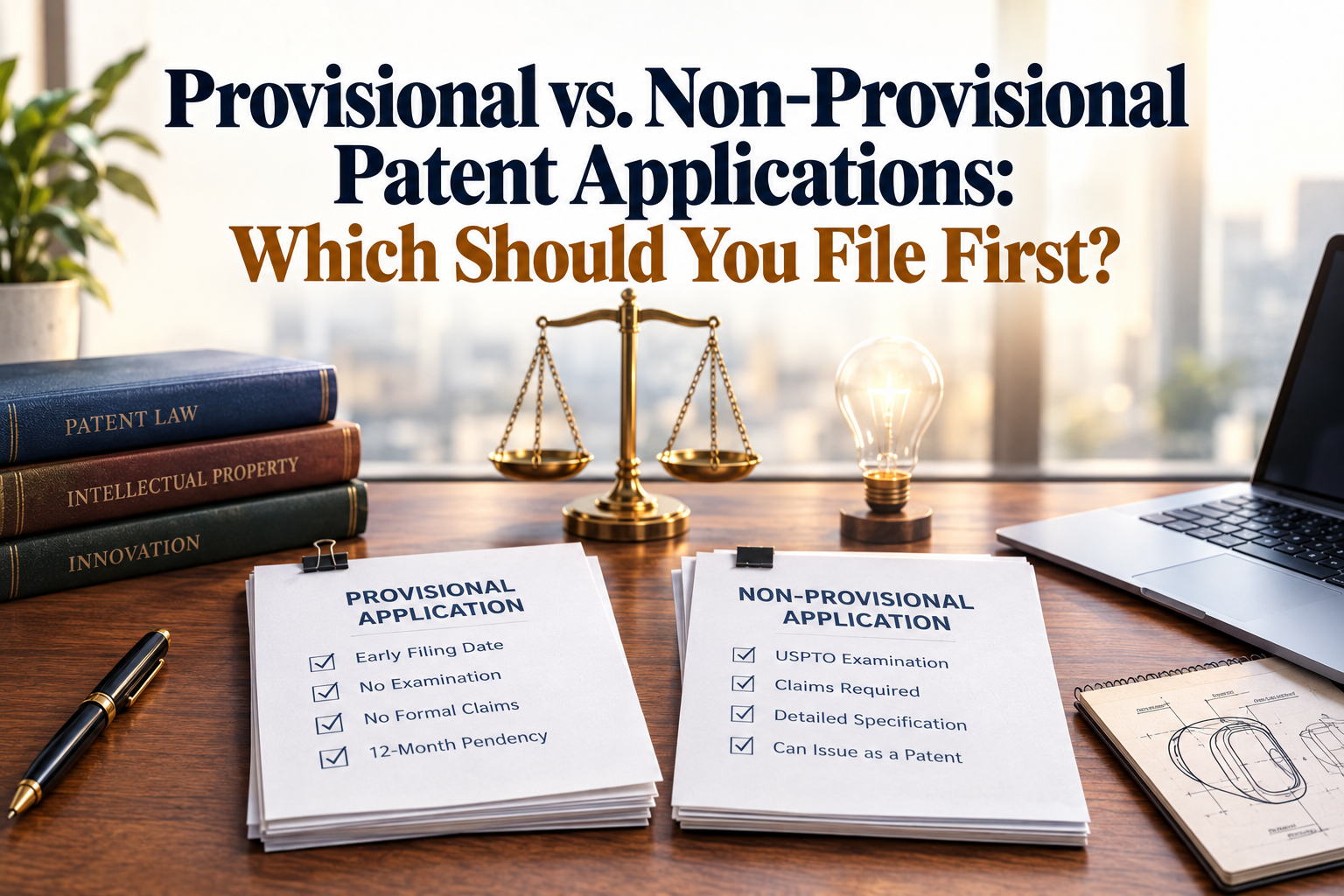
Once an inventor decides an idea may be worth patenting, another decision follows quickly: begin with a provisional application, or go directly to a non-provisional application? The answer depends on more than cost. The stage of development, upcoming launches or investor discussions, how fast the technology is changing, and international goals all shape the choice. One clarification first, because the vocabulary causes confusion: there is no such thing as a “provisional patent.” There is only a provisional application, which never becomes a patent on its own. A non-provisional application is the one the USPTO examines and the only one that can issue. Choosing between them is a strategic decision, not a choice between a short form and a long one.
What a Provisional Application Does, and Does Not Do
A provisional application establishes an early U.S. filing date for a utility or plant invention. It is not examined, does not require formal claims, and generally remains pending for 12 months, during which the inventor may mark the invention “patent pending.” To keep that date, the applicant must file a non-provisional application within the 12 months and properly claim the benefit of the provisional. The filing date carries over only for subject matter the provisional adequately disclosed, and a provisional cannot be amended after filing to add what was left out.
That last point is the one inventors most often get wrong. A provisional consisting of a few sketches and a broad description, filed on the theory that the details can be “filled in later,” may establish a date for almost nothing of value. We cover the timing side of this, including disclosure risk and investor presentations, in a separate article on when to file a patent. The rest of this article is about the comparison itself.
What a Non-Provisional Application Contains and Starts
A non-provisional utility application is the one the USPTO examines. It includes a detailed specification, one or more claims defining the invention’s legal boundaries, drawings where needed, an inventor oath or declaration, and filing, search, and examination fees. After filing, the application is routed to the appropriate USPTO technology center and eventually reaches a patent examiner, who evaluates it against the requirements for patentability, including novelty and non-obviousness, and may issue one or more Office Actions rejecting or objecting to claims. The applicant responds with arguments, amendments, or evidence; that back-and-forth is patent prosecution, and it typically runs well over a year. If the claims are ultimately allowed, the application issues as a patent.
Two consequences of filing a non-provisional are easy to overlook. First, the application is normally published 18 months after its earliest claimed filing date, which means a provisional filed today starts the clock toward public disclosure of the application’s contents, unless a non-publication request is filed and the applicant forgoes foreign filing. Second, the 20-year patent term runs from the non-provisional filing date, not the provisional date; the USPTO confirms that the provisional’s 12-month pendency is not counted against the term. A provisional therefore buys up to a year of priority at no cost in patent term.
When Filing a Provisional First Makes Sense
For many early-stage companies, the advantage of a provisional is flexibility. Consider a Pasadena hardware startup with a working prototype whose circuit layout and firmware are still being optimized. A well-drafted provisional describing the invention as it exists, including the alternatives the engineers are weighing, establishes a date before the team demonstrates the device to potential manufacturing partners. During the following year the company refines the design, tests demand, raises capital, and decides whether the invention justifies the cost of a full non-provisional and prosecution. If it does not, the provisional simply lapses, unpublished, and nothing has been disclosed to competitors.
That is the use case a provisional is designed for: an invention that is real and describable but still evolving, with a business reason to lock in a date now and defer the larger investment. It is not a reason to postpone decisions until the deadline approaches, and it is not a substitute for a careful disclosure.
When Going Directly to a Non-Provisional Is the Better Call
Not every inventor benefits from a provisional. If the invention is fully developed, the technical disclosure is mature, and the applicant wants examination to begin, filing a non-provisional directly is more efficient. An established company that has finished research and development, finalized the commercial version, and already knows which features warrant protection gains little from a provisional stage; it adds a year before examination starts without adding meaningful optionality.
Going direct also makes sense when speed to an issued patent matters commercially, for instance when a company expects to need the patent for licensing or enforcement or intends to request prioritized examination. And because the non-provisional’s own filing date starts the patent term, an applicant who files direct with a mature disclosure gives up nothing in priority while gaining a year of examination progress. A provisional should serve a specific purpose, not be an automatic first step in every matter.
Multiple Provisionals as an Invention Evolves
Technology rarely stands still for a year. Because a provisional cannot be amended, inventors who develop significant new features after the first filing may file additional provisionals covering the new material as it matures. The later non-provisional can then claim the benefit of each provisional for the subject matter that provisional supports, provided it is filed within 12 months of the earliest provisional it relies on and at least one inventor is common to each. This lets a company build its filing strategy around actual development milestones rather than trying to predict every improvement on day one. The tradeoff is complexity: more filings mean more deadlines, and a business should keep a clear patent calendar showing exactly what each application supports.
The 12-Month Deadline Controls More Than the U.S. Filing
A provisional is abandoned 12 months after filing. To keep its date, the non-provisional must be filed within that window and claim priority. The USPTO does allow benefit to be restored if the non-provisional is filed within two months after the deadline, the delay was unintentional, and a petition and fee are submitted, but that is a safety net for mistakes, not a planning tool.
What many inventors do not realize is that the same 12 months is also the international deadline. The priority period for foreign and PCT filings runs from the provisional’s filing date, so the non-provisional deadline, any foreign national filings, and a PCT application all fall due on the same day. A company that wants protection outside the United States must have decided and budgeted for it before that date. For that reason, the review that should happen several months ahead of the deadline covers more than the U.S. filing: how the invention has changed, what new subject matter needs its own support, which countries matter commercially, who the correct inventors are, and whether the opportunity still justifies the investment.
Provisionals Are Not Available for Design Patents
A provisional application cannot be filed for a design. Design patents protect the ornamental appearance of an article rather than how it works, and an applicant pursuing design protection files a design application directly. This matters for consumer products that combine functional innovation with distinctive appearance: a company developing a new wearable device might file a provisional, then a non-provisional, for the technical functionality, and a separate design application for the product’s shape, each on its own timeline and with its own requirements.
Frequently Asked Questions
Does a provisional patent application protect my invention for 12 months?
No. A provisional application does not create enforceable rights. It establishes a filing date and permits use of “patent pending,” but a non-provisional application must be filed within 12 months to pursue an actual patent.
Is a provisional application always cheaper?
The USPTO filing fee and the initial preparation are generally lower, but the non-provisional still has to be prepared and prosecuted later. A provisional filed cheaply with a thin disclosure can cost far more than it saves if the subject matter that matters is not supported.
Can I add new material when I file the non-provisional?
Yes, but the new material does not get the provisional’s filing date. Priority applies only to subject matter the provisional adequately supports. New developments made during the year are often better protected by an additional provisional.
What happens if I miss the 12-month deadline?
The provisional is abandoned. The USPTO may restore the benefit if the non-provisional is filed within two months after the deadline, the delay was unintentional, and a petition and fee are submitted. Beyond that, the filing date is lost, and any public disclosure in the meantime may affect patentability.
Does the 12-month provisional period shorten my patent term?
No. The 20-year term of a utility patent runs from the non-provisional filing date, and the USPTO does not count the provisional’s pendency against it. A provisional can add up to a year of priority without reducing the term.
Choose the Filing Strategy That Fits the Invention
There is no universal rule that every inventor should file a provisional first. A provisional is an effective way to establish an early date while development, fundraising, and commercial planning continue, but its value depends on the quality of the disclosure and on following through before the deadline. For an invention that is already mature, going directly to a non-provisional is the more direct path to examination. The key is knowing why a particular strategy is being used and how it supports the commercial goals around the invention, from investor conversations to launch.
At Omni Legal Group, our Los Angeles patent attorneys work with inventors, entrepreneurs, startups, product developers, and established companies to evaluate provisional and non-provisional strategies, filing timing, patentability, priority issues, and long-term portfolio development, and to align patent filings with product development, investment, and business growth.
The question is not simply whether to file provisional or non-provisional first. The more important question is which filing strategy gives your innovation the strongest foundation for what comes next.
Contact Omni Legal Group today to schedule a confidential strategy session with one of our patent lawyers in Los Angeles. Call 855.433.2226 to discuss your invention, filing timeline, development plans, and the patent strategy that may best support your long-term business objectives.