
California businesses file thousands of trademark applications every year in an effort to secure exclusive rights to their brand names, logos, slogans, and product identities. In a state driven by innovation, entertainment, technology, fashion, and e-commerce, brand identity is often one of a company’s most valuable assets. But despite the importance of trademark protection, many applications are rejected by the United States Patent and Trademark Office (USPTO), sometimes after businesses have already invested heavily in marketing, packaging, website development, and advertising.
A trademark rejection is more than a bureaucratic setback. It can delay product launches, disrupt fundraising efforts, force costly rebranding, and create legal uncertainty around your most important brand assets. In highly competitive California markets, where similar businesses often operate in overlapping industries, the risk of conflict or refusal is even greater.
Understanding why the USPTO rejects trademark applications, and how to proactively avoid those pitfalls, is not just a legal technicality. It is a strategic business decision that can protect your investment, preserve your brand equity, and prevent expensive course corrections down the road. With proper planning and experienced trademark counsel, many common rejections can be anticipated and avoided before they ever become obstacles.
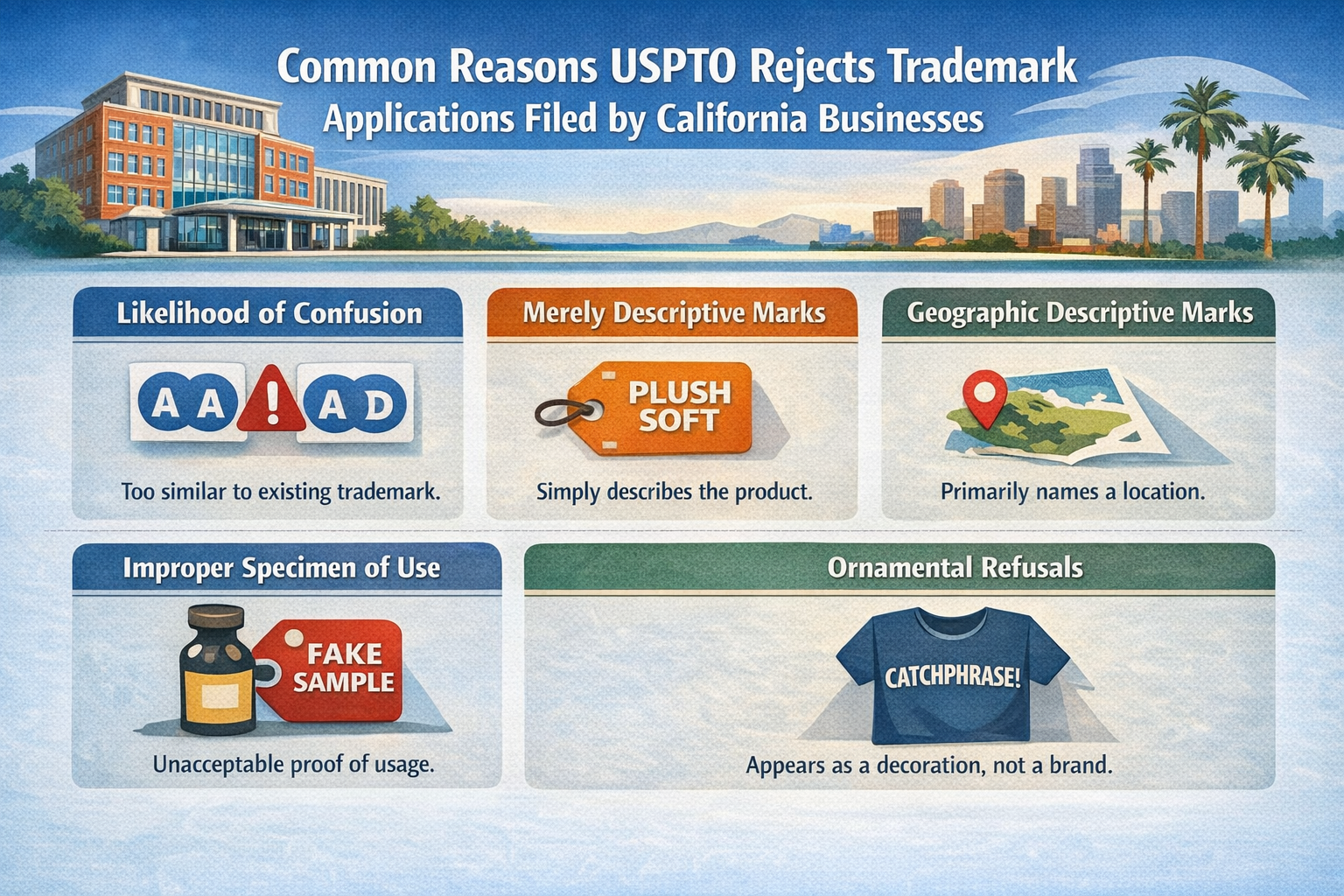
Likelihood of Confusion
The most frequent rejection ground is likelihood of confusion with an existing registered or pending trademark. The USPTO examines whether consumers might confuse your mark with another already in use for related goods or services.
Many California entrepreneurs underestimate how broadly the USPTO interprets “related” goods and services. Your craft brewery’s name might conflict with an existing winery’s trademark, or your tech startup’s brand could be too similar to a software company in a different niche. The marks don’t need to be identical. They simply need to be similar enough that consumers might believe they share a common source.
California’s crowded marketplace makes this particularly challenging. With countless businesses operating in overlapping industries, finding truly distinctive marks requires comprehensive searching beyond a simple Google query or USPTO database check.
Merely Descriptive Marks
The USPTO frequently rejects marks that merely describe the goods or services offered. If your mark directly describes a feature, quality, ingredient, or characteristic of your product, it likely won’t qualify for registration.
California businesses often stumble here with seemingly clever names. “Golden State Solar Panels,” “San Diego Fresh Seafood,” or “Quick California Delivery” all face rejection because they simply describe what the business does or where it operates. These marks don’t distinguish your business from competitors. Rather, they describe what any similar business might offer.
Descriptiveness rejections frustrate applicants who’ve already invested in branding, signage, and marketing materials. The mark might work commercially, but federal registration requires distinctiveness that sets you apart.
Geographically Descriptive Marks
Related to descriptiveness, the USPTO rejects marks that are primarily geographically descriptive. “Silicon Valley Software” or “Napa Valley Wines” describe where the goods originate rather than identifying a unique source.
California applicants frequently encounter this obstacle because the state’s regional identities carry commercial appeal. However, unless your mark has acquired distinctiveness through extensive use, typically requiring five years of substantially exclusive and continuous use, geographic descriptiveness will bar registration.
Ornamental Refusals
California’s fashion, apparel, and lifestyle brands often face ornamental refusals. If your design or slogan appears on products merely as decoration rather than as a brand identifier, the USPTO will refuse registration.
Phrases on t-shirts, decorative logos on accessories, or stylized text that consumers perceive as ornamentation rather than source identification commonly receive this rejection. The challenge is proving that consumers view your mark as identifying the brand, not just embellishing the product.
Improper Specimens of Use
One of the most common and avoidable reasons the USPTO rejects trademark applications is the submission of improper specimens of use. A specimen is not just a sample image; it is legal proof that your trademark is actually being used in commerce in connection with the goods or services listed in your application. If the specimen does not clearly demonstrate real-world commercial use, the application will be refused.
For goods, the mark must appear directly on the product, its packaging, labels, tags, or a legitimate point-of-sale display. Simply placing a logo on a website without showing the product available for purchase may not be enough. For services, the specimen must show the mark used in the actual marketing or offering of the services, such as on a live website, brochure, or advertisement where customers can engage or request the service.
Common mistakes include submitting mockups, digitally altered images, “coming soon” webpages, incomplete websites, or promotional materials that reflect an intent to use the mark rather than proof of current use. The USPTO carefully scrutinizes specimens, and even small inconsistencies can trigger an Office Action. These technical errors may seem minor, but they can lead to delays, additional legal costs, or even abandonment of the application if not corrected properly.
Ensuring your specimen meets USPTO standards from the outset can prevent unnecessary setbacks and keep your registration process moving forward smoothly.
How Trademark Attorneys Prevent Rejections
Experienced trademark attorneys conduct comprehensive clearance searches that go beyond surface-level database queries, identifying potential conflicts before you file. They help you select inherently distinctive marks or develop strategies for descriptive marks, such as disclaiming unregistrable portions or pursuing alternative protection.
Attorneys also prepare applications with proper classifications, accurate descriptions of goods and services, and appropriate specimens demonstrating actual use. When rejections occur, they craft persuasive responses addressing concerns raised by the USPTO.
For California businesses building valuable brands, investing in professional trademark counsel from the start prevents costly rejections, refiling fees, and potential rebranding expenses down the road.
Have Questions? Contact an Experienced Los Angeles Trademark Attorney
A trademark rejection is not just a paperwork issue, it can disrupt your launch timeline, weaken investor confidence, and force expensive rebranding efforts at the worst possible time. In California’s competitive business landscape, your brand is often your most valuable asset. Protecting it properly from the outset is far more cost-effective than fixing problems later.
Whether you are launching a startup in Los Angeles, expanding an established brand, or rebranding after growth, a proactive trademark strategy is essential. The right legal guidance can help you select a strong, distinctive mark, conduct comprehensive clearance searches, avoid common USPTO refusals, and respond effectively if an Office Action is issued. Filing without a clear strategy may seem faster or less expensive upfront but mistakes can cost far more in the long run.
At Omni Legal Group, our experienced Los Angeles trademark attorneys work with entrepreneurs, creators, technology companies, fashion brands, entertainment businesses, and growing enterprises across California. We take a strategic, business-focused approach to trademark protection, helping clients not only secure registrations, but also build brand portfolios that support long-term expansion, licensing, and enforcement.
If you are considering filing a trademark, or have already received a USPTO rejection, now is the time to speak with knowledgeable legal counsel. Early intervention can save time, preserve your brand investment, and strengthen your position before small issues become major setbacks.
Contact Omni Legal Group today to schedule a confidential consultation with a trusted Los Angeles intellectual property attorney. Call 855.433.2226 to speak with our legal team and take the next step toward securing, protecting, and strengthening your brand with confidence.
To learn more, please visit www.OmniLegalGroup.com.