
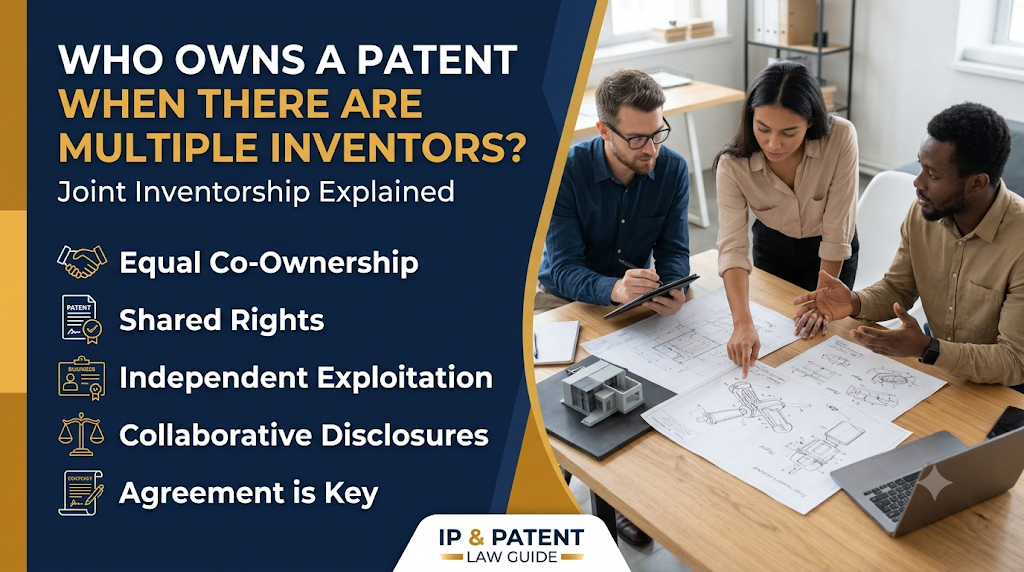
Innovations are rarely created alone. Co-founders develop a product together, engineers work on different parts of the same technology, university researchers share a discovery, or employees and outside consultants collaborate over months. When several people contribute, the question of who owns the patent follows quickly, and the answer begins with a distinction many founders miss. Inventorship and ownership are not the same thing. Inventorship is a legal determination about who contributed to the conception of what the patent claims. Ownership is about who holds the rights, and it can be moved by assignment, employment agreements, and company policies to a business, a university, or an investor. The two start in the same hands and often end in different ones. Understanding that early prevents disputes that surface later in fundraising, licensing, enforcement, and the sale of the company itself.
Joint Inventorship Depends on Contribution, Not Title or Equity
Under federal patent law, an invention can have more than one inventor, and joint inventors need not work together at the same time, contribute the same amount, or contribute to every claim. What matters is whether each person made a legally sufficient contribution to the conception of at least one claimed element. Inventorship is therefore not determined by job title, seniority, equity percentage, or who funded the project. A CEO who paid for development is not an inventor. A manager who supervised the engineering team does not qualify by virtue of supervision. An engineer who conceived a feature that appears in one claim may qualify even if someone else conceived most of the product.
Imagine two founders developing a medical monitoring device. One conceives the core sensor system; months later the other develops a novel method of processing the sensor data, and the application includes claims to both. Their contributions were made at different times, to different parts of the technology, in different amounts. Both are joint inventors. Because inventorship is tied to the claims, it should be evaluated against what the application actually claims, not against assumptions about who did most of the work.
Being an Inventor Does Not Mean Staying an Owner
A company cannot be an inventor; inventors are the people who conceived the claimed invention. But patents and applications are freely transferable by written assignment, and in a company that is exactly what happens. Three engineers who jointly invent technology at a startup must all be named as inventors, and if they signed invention assignment agreements, the startup owns the patent while the three remain named on its face. Their inventorship does not disappear when ownership changes.
The wording of those agreements matters more than most founders realize. An agreement in which an inventor “agrees to assign” future inventions is a promise that may require a further signature later; one in which the inventor “hereby assigns” them operates as a present transfer that takes effect automatically when the invention is made. Courts have treated the difference as decisive when a later, competing assignment appears. Assignments should also be recorded with the USPTO: an unrecorded assignment can be void against a later purchaser who had no notice of it, and a clean recorded chain of title is what investors and acquirers expect to find.
The Default Rules for Joint Owners Surprise Most Founders
When several inventors keep their interests rather than assigning them to one entity, federal law supplies default rules that few founders would choose. Absent an agreement, each joint owner may make, use, sell, offer to sell, or import the patented invention without the consent of the others and without accounting to them for any profits. Each may also grant non-exclusive licenses to third parties on the same terms. Two co-founders jointly own a patent; the relationship sours; one leaves. Unless an agreement says otherwise, the departing founder may practice the invention, or license a competitor to practice it, and owe the company nothing.
The second default rule is less known and arguably worse. All co-owners generally must join as plaintiffs in an infringement suit, and a co-owner who declines cannot usually be forced. One disaffected co-owner can therefore block the others from enforcing the patent at all. For a startup whose value rests on exclusivity, undivided joint ownership among individuals is close to the worst available structure, which is why assignment of every inventor’s interest to the company, early, is the standard advice.
One Inventor Cannot Transfer the Others’ Interests
A joint inventor can assign only what that inventor holds. If three inventors have not assigned their rights and one signs an assignment to a startup, the startup becomes a partial owner alongside the other two; it does not acquire “the patent.” Companies sometimes discover years later, during a financing or acquisition, that they own a third of a patent they believed was theirs. Confirming that an assignment exists from every person with an interest is a basic step that is skipped surprisingly often.
Founder Agreements Should Capture Pre-Formation IP
Founders frequently build prototypes, write software, and even file patent applications before the corporation exists. When the entity is formed, anything developed before formation that the business depends on should be assigned to it. A capitalization table showing that a founder holds 40 percent of the company says nothing about whether the company owns that founder’s patent rights; equity and IP ownership are separate questions. Founder agreements and IP assignment documents should establish that patents, applications, software, trade secrets, and related inventions intended for the business actually belong to it. This is also the point at which investors will look first.
Employee Inventions in California Have a Statutory Limit
An employee who contributes to conception is an inventor regardless of the employer’s organizational chart. Whether the employer owns the result depends on the employment agreement, and in California, on Labor Code section 2870. That statute makes an invention assignment provision unenforceable to the extent it reaches an invention the employee developed entirely on their own time, without using the employer’s equipment, supplies, facilities, or trade secrets, unless the invention either relates to the employer’s business or actual or demonstrably anticipated research and development, or results from work the employee performed for the employer. Section 2872 requires the employer to give written notice of this limitation when the agreement is signed. California employers should draft invention assignment provisions with the carve-out stated and should not assume every idea an employee has belongs to the company. Employees, for their part, should understand that side projects in the employer’s field are often not protected by the statute.
University Research Adds Another Layer
University inventions involve professors, graduate students, sponsors, and often federal funding, which carries its own ownership and reporting obligations. The researchers who contributed to conception are the inventors; ownership is typically governed by university IP policy, employment terms, research and funding agreements, and written assignments, so a researcher is usually named as inventor while the university owns the rights. A company licensing university technology should confirm that the university actually holds the interests being licensed, whether other institutions, sponsors, or inventors retain rights, and what commercialization restrictions apply.
Inventorship Errors Can Be Corrected, but Should Be Avoided
Because inventorship follows the claims, the inventor list should be evaluated when the application is prepared and again whenever claims change materially during prosecution; if the final claims differ substantially from those filed, the inventorship should reflect who contributed to what is ultimately claimed. Federal law provides procedures to add an omitted inventor or remove one wrongly named, and errors made without deceptive intent are generally correctable. The better course is to treat inventorship as a legal determination rather than an administrative formality, because an inventorship dispute is also an ownership dispute, and ownership gaps are among the first things due diligence uncovers.
Frequently Asked Questions
Can two or more people be listed as inventors on the same patent?
Yes. Federal law permits joint inventorship, and joint inventors need not contribute equally, work together at the same time, or contribute to every claim. Each must have made a legally sufficient contribution to the conception of at least one claimed element.
Does being named as an inventor mean I own part of the patent?
Not necessarily. Inventorship and ownership are separate. An inventor initially holds rights but can transfer them by written assignment, and in most companies does so under an employment or founder agreement. The inventor stays named on the patent while the company owns it.
Can one joint patent owner use or license the patent without the others?
Absent an agreement, yes. Federal law allows each joint owner to practice the invention and grant non-exclusive licenses without the consent of, or any accounting to, the other owners. All co-owners generally must join to sue for infringement, so one can also block enforcement. Joint ownership should be governed by a written agreement or avoided by assignment to a single entity.
Can my employer claim an invention I developed on my own time in California?
It depends. California Labor Code section 2870 prevents an employer from requiring assignment of an invention developed entirely on the employee’s own time without employer resources or trade secrets, unless the invention relates to the employer’s business or research or results from work done for the employer. Side projects in the employer’s field often fall outside the protection.
What happens if an inventor was accidentally left off a patent application?
Federal law provides procedures to correct inventorship in applications and issued patents. Because an inventorship error can also be an ownership problem, suspected errors should be addressed promptly with patent counsel rather than left for a later transaction to uncover.
Clear Patent Ownership Starts with Identifying the Right Inventors
When several people contribute to an invention, identifying the inventors is the first step. The business must then make sure it owns what they invented: that every inventor’s interest has been assigned with present-assignment language, that the assignments are recorded, that founder and employee agreements reach the inventions the company depends on within the limits California law allows, and that no collaborator, university, or contractor retains an interest the company assumed it held. These questions are easiest to answer before the patent is worth anything.
At Omni Legal Group, our Los Angeles patent attorneys work with inventors, founders, technology companies, research teams, and established businesses on patent applications, inventorship analysis, assignments, founder and employee IP agreements, ownership disputes, licensing, and patent enforcement, so that the people who invented the technology are correctly named and the business actually owns the rights it depends on.
Having the right people listed as inventors is important. Making sure the business owns the patent rights it depends on can be just as important.
Contact Omni Legal Group today to schedule a confidential strategy session with one of our patent lawyers in LA. Call 855.433.2226 to discuss joint inventorship, patent ownership, assignments, employee inventions, licensing, or strategies for building a clear and commercially valuable patent portfolio.