Omni Legal Group logo
Omni Legal Group Blog Omni Legal Group Blog
  • ABOUT US
  • SERVICES
    • BUSINESS LAW
      • BUSINESS LITIGATION
      • BUSINESS FORMATIONS/TRANSACTIONS
      • BUSINESS CONSULTANCY
    • PATENTS
      • PATENT FILING
        • DESIGN PATENT
        • UTILITY PATENT
      • PATENT LITIGATION
    • Trademarks
      • TRADEMARK FILING
        • TRADEMARK REGISTRATION
        • TRADEMARK TRANSFERS
        • TRADEMARK SEARCHES
        • INTERNATIONAL TRADEMARKS
      • TRADEMARK LITIGATION
    • copyrights
    • Cyber Law
    • Trade Secret LAW
    • Mediation
  • CONTACT US
    • Los Angeles
    • Beverly Hills
    • Santa Monica
  • RESOURCES
    • VIDEOS
    • Publications
    • Blog
    • HELPFUL LINKS
    • IN THE NEWS
    • FAQ’s
  • Philanthropy
  • ABOUT US
  • SERVICES
    • BUSINESS LAW
    • PATENTS
    • Trademarks
    • copyrights
    • Cyber Law
    • Trade Secret LAW
    • Mediation
  • CONTACT US
    • Los Angeles
    • Beverly Hills
    • Santa Monica
  • RESOURCES
    • VIDEOS
    • Publications
    • Blog
    • HELPFUL LINKS
    • IN THE NEWS
    • FAQ’s
  • Philanthropy
  •  

Blog Old

Home / Blog Old - Page 23

Our Latest News

Does laCalifornienne’s colorful customization of authentic Rolex timepieces constitute fair use?

  • Rolex

            Late in 2019, Rolex filed a lawsuit in the United States District Court for the Central District of California alleging that California-based laCalifornienne has been marketing and offering for sale counterfeit timepieces bearing Rolex’s trademarks. Rolex has been offering for sale its iconic timepieces for more than 114 years, including one of its most popular designs, the Rolex Oyster Perpetual. Rolex possesses trademark rights in and to ROLEX, OYSTER, and OYSTER PERPETUAL, in addition to trade dress in the designs of its timepieces. The lawsuit lists causes of action for trademark infringement, counterfeiting, and false designation of origin.

            Since its inception in 2016 in Los Angeles, laCalifornienne’s business model has comprised taking vintage Rolex and Cartier timepieces, replacing the original watch crystals, refashioning the bezels, and altering the dials by stripping the paint and finish therefrom and repainting and refinishing them in various vibrant colors. However, such watches still contain all original Rolex indicia. As a result, Rolex asserts that such altered watches “no longer attain the aesthetic” nor “perform or function to the same quality standards” as unaltered, original pre-owned Rolex watches. laCalifornienne sells its timepieces to consumers for between $6,500 to $14,000.

            Prior to bringing suit, Rolex received possession of two laCalifornienne timepieces bearing the Rolex trademark and indicia. The first, an original Oyster Perpetual, was purchased directly from an authorized-laCalifornienne retailer. The second was received at a Rolex service center in Pennsylvania for servicing. The first watch did not contain the alleged infringer’s name while the second did contain “laCalifornienne” added to the dial at the six o’clock position. Rolex alleges that laCalifornienne’s printing of its name on the dial of its altered watches, which continue to bear one or more of Rolex’s registered trademarks, including ROLEX and OYSTER PERPETUAL, cannot dispel their liability for infringement.

            Rolex alleges that laCalifornienne’s use of Rolex’s trademarks in this manner creates the erroneous impression that its products and services emanate or originate from Rolex, and/or that said products and services are authorized, sponsored, or approved by Rolex, though this is not the case. Moreover, Rolex is unable to monitor, enforce or maintain its quality control standards on the altered Rolex products assembled and offered for sale by laCalifornienne. In this way, Rolex alleges laCalifornienne has been unjustly enriched by illegally using and misappropriating Rolex’s intellectual property for their own financial gain.

            In its answer to Rolex’s complaint, laCalifornienne not only denies the allegations but also argues its watch modifications constitute fair use. Nominative fair use allows for the reasonably necessary use of another party’s trademark solely to identify that party or its products. Such fair use is allowable so long as the use is descriptive and does not suggest sponsorship or endorsement by the trademark holder. To prevail on this defense, the court will need to determine whether, by adorning Rolex timepieces in this manner, laCalifornienne has attempted to deliberately confuse and deceive the consuming public and appropriate the cachet of Rolex. Rolex is likely to argue laCalifornienne is making use of its marks in an attempt to benefit from the proven reputation and sheer appeal of Rolex’s watches.

            Unlike the majority of counterfeiting cases in which brands file lawsuits against individuals or companies for marketing and offering for sale outright knock-offs, Rolex alleges laCalifornienne’s watches are counterfeit despite the fact that they contain authentic Rolex parts. Specifically, Rolex does not take issue with laCalifornienne swapping out its traditional metal wristbands for colorful leather ones because this does not impair the functioning of the watches themselves. Instead, Rolex particularly takes issue with the fact that laCalifornienne customizes the watches with colorful parts, such as dials and crystals. Rolex claims such substituted parts are not properly fitted to the watch and are likely to adversely affect the dial and movement of the watch. This position is consistent with Rolex’s long-standing policy dictating that the alteration of its timepieces to include non-authentic Rolex parts, that is, parts not approved by Rolex, transforms an authentic watch into a counterfeit.

Read More
Can Google escape consequences for allegedly infringing Sonos’ patented technology?

  • Sonos Technology – Patent Infringement

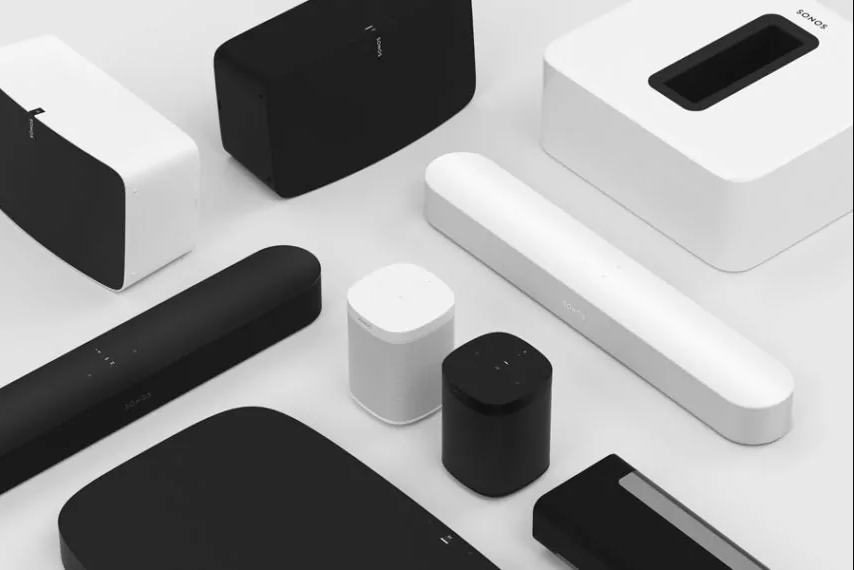
            Last week, Sonos filed two separate lawsuits against Google alleging the search engine giant knowingly infringed upon its patented technology in the development of Google’s own smart speaker systems. One lawsuit was filed in the Central District of California, seeking damages and an injunction, and the other with the International Trade Commission, seeking a ban on Google’s infringing devices. In particular, Sonos complains of the Google Home series as infringing multiple of its issued patents.

            Patent owners possess the exclusive legal right to exclude others from making, using, selling, or offering for sale the invention described in the claims. Patent infringement occurs when a product or service meets all of the limitations of at least one independent claim of the patent. There is no requirement that the allegedly infringing party have knowledge of the existence of the patent in order to be held liable. However, if the infringing party did have knowledge of the patent prior to the accused-of conduct, that party may be liable to the patent owner for up to three times the amount of damages assessed.

            In its complaint, Sonos alleges to have pioneered the wireless multi-room audio system in the early 2000s. The company brought its first commercial product to market in 2005. The Santa Barbara-based company has been granted more than 750 patents by the United States Patent and Trademark Office and currently has 420 pending patent applications. These patents cover various aspects of Sonos’ wireless multi-room audio system, including setting up a playback device on a wireless local area network, managing and controlling groups of playback devices, and synchronizing playback of audio within groups of playback devices.

            Prior to Sonos’ innovation, multi-room audio systems were dependent on a centralized receiver hard-wired to each individual passive speaker throughout a home or business. Sonos changed this landscape by relying on intelligent, networked playback devices to deliver sound wirelessly. Sonos alleges its system is easy to set up and use and is customizable and is readily integrated with other technologies and services. Moreover, Sonos’ products are compatible with numerous third-party music streaming services, many of which have integrated their services into the Sonos platform.

            In 2013, Google and Sonos worked together through a partnership to integrate Google Play Music into the Sonos platform. During this partnership, Google gained knowledge of Sonos’ patented multi-room technology. In particular, Google was able to view Sonos’ proprietary technology in great detail due to the especially deep integration of Google Play Music therewith. In 2014, Google’s Google Play Music was launched on the Sonos platform.

            Two years after Google and Sonos partnered together, Google launched its first wireless multi-room audio product, Chromecast Audio, which is an audio adapter/dongle that can turn a speaker with an auxiliary port into a wireless, networked speaker. This is the first device which Sonos claims infringes its patents. Since Chromecast Audio’s release, Google has, according to Sonos, proliferated its use of Sonos’ patented technology. Indeed, Google has produced more than a dozen allegedly infringing products, including Google Home, Google Home Mini, Google Home Max, and Pixel phones, tablets, and laptops.

            In the complaint, Sonos lists five patents that were allegedly infringed by Google, though Sonos alleges that it believes Google violated roughly 100 different patents. Some of the features alleged by Sonos to be infringed by Google include setting up a playback device on a wireless local area network, adjusting group volume of playback devices, and synchronizing playback of audio within groups of playback devices. To make matters worse for Sonos, Google sells its Google Home Mini at a fraction of the cost of a Sonos comparable product. Google sells the Mini for $49 and has even offered them for free in a partnership with Spotify, thereby causing a massive influx of Google smart speakers that will enter the market.

            Sonos has warned Google of its infringement on at least six separate occasions dating back to 2016. Specifically, Sonos first raised the issue of infringement in August 2016 and most recently by providing a pre-filing copy of the complaint to Google. In addition, Sonos alleges Google has been aware of Sonos’ patents well before August 2016. This is due, in part, to Sonos’ previously-filed patent litigation against D&M, another competitor of Sonos and Google, in a lawsuit which garnered media attention and resulted in a jury verdict for Sonos.

            Interestingly, Sonos publicly maintains that Amazon has similarly infringed upon its patented technology but claims it decided to sue only Google as they “couldn’t risk battling two tech giants in court at once.” Unsurprisingly, similar to Google, Amazon denies such claims and maintains that the Echo family of devices was developed independently by Amazon. For its part, Google also denies Sonos’ infringement claims and has stated that it is “disappointed” by this lawsuit.

Read More

When can trademark infringers be forced to forfeit their ill-begotten profits?

  • Romag Fasteners

            In 2010, Romag Fasteners, a company that produces and sells magnetic snaps, fasteners and closures, brought suit in the United States District Court for the District of Connecticut against Fossil Inc., as well as Macy’s, alleging patent and trademark infringement. According to the lawsuit, Fossil had been a licensee of Romag’s patent-protected magnetic closures but had switched to an unapproved supplier, which Romag alleges sold counterfeit Romag magnetic snaps. Thus, certain Fossil handbags sold in the United States were found to contain said counterfeit snaps. In this manner, not only did Fossil run afoul of Romag’s patents for the metal components, Fossil was also accused of violating Romag’s trademarks because the knock-off parts bore the “ROMAG” mark. Moreover, due to the existence of the agreement between the two parties in connection with which Fossil agreed to use Romag closures for its profits, Romag contends that Fossil knowingly adopted and used the Romag mark without its consent.

            Trademark infringement involves the unauthorized use of a trademark on or in connection with goods and/or services in a manner that is likely to cause consumers to be confused, deceived, or mistaken as to the source of the goods and/or services. When trademark infringement is found to be willful, the infringer is required to forfeit any profits realized from sale under the infringing mark.

            After a jury trial, Fossil was found liable for both patent and trademark infringement. The jury rendered advisory awards, including a reasonable royalty award of $51,000 for patent infringement and an award of $6.7 million of Fossil’s profits for willful trademark infringement. Thereafter, the District Court reduced the patent damages award and simultaneously decided that Romag could not recover Fossil’s profits for trademark infringement because the jury had not found the infringement to be willful. Rather, the jury had determined that Fossil had acted with “callous disregard” for Romag’s trademark rights. Upon appeal, the United States Court of Appeals for the Federal Circuit affirmed the award.

            In the Federal Circuit appeal, Romag argued that Fossil cannot invoke a laches defense to patent infringement and that the District Court erred in disallowing it from recovering Fossil’s profits without proving that the infringer acted willfully. Laches is a defense when the plaintiff has unreasonably delayed in making a claim and the defending party is prejudiced as a result. Regarding this argument, the Federal Circuit determined that laches remains a defense to legal relief in patent infringement cases because Congress codified the same. As to Romag’s contention that it is entitled to Fossil’s profits regardless of whether it proved that Fossil acted willfully, the Federal Circuit followed Second Circuit precedent in finding that because Romag did not prove that Fossil acted willfully, Romag is not entitled to recover Fossil’s profits. The decision regarding Fossil’s profits was then appealed to the United States Supreme Court.

            Through this case, the Supreme Court will decide whether, under Section 35 of the Lanham Act, 15 U.S.C. § 1117(a), willful infringement is a prerequisite for an award of an infringer’s profits for a violation of Section 43(a), 15 U.S.C. § 1125(a). Currently, across the twelve circuit courts, there exists a split of precedents. In particular, six circuits, including the first, second, eight, ninth, tenth, and District of Columbia, strictly require willful infringement in order to recover an award of infringer’s profits. On the other hand, the remaining six circuits, including the third, fourth, fifth, sixth, seventh, and eleventh, have interpreted amendments to the statute to permit an award of the infringer’s profits absent a finding of willful infringement, reasoning that Congress’ failure to include the word “willfulness” in the relevant section of the statute indicated a desire to supersede the judicially created doctrine which requires willfulness. Instead, these circuits consider intent to be merely one of several factors to be considered in balancing the equities. To resolve this circuit court split regarding willfulness, the Supreme Court granted Romag’s petition for writ of certiorari in June 2019. Oral arguments are set to begin January 14, 2020.

Read More

Can mere adjustments in packaging style and prominence of a trademarked name resolve trademark and trade dress infringement litigation?

  • Nespresso – Trademark Infringement

            In April, Nespresso filed a lawsuit in the United States District Court for the Southern District of New York against Jones Brothers claiming that its prominent use of the phrase “Nespresso-compatible” to promote its coffee capsules infringed its trademark. In addition, Nespresso claimed the capsules themselves infringed the coffee giant’s trade dress. Overall, Nespresso alleges Jones Brothers “built an entire business by unlawfully trading off Nespresso’s valuable assets and goodwill.”

            Jones Brothers was founded in 2013 offering “Nespresso Compatible” capsules for use with Nespresso® machines and other brewers. Starting in the latter-half of 2018, Nespresso issued multiple letters to Jones Brothers, placing Jones Brothers on notice of its allegedly infringing activities. In these letters, Nespresso explained that Jones Brothers was improperly using Nespresso’s trademarks to advertise and sell its infringing capsules. Jones Brothers failed to respond to any of the three letters issued on behalf of Nespresso.

            Nespresso is the exclusive licensee of a number of federally registered trademarks and applications covering the “Nespresso” name. Societe des Produits Nestle S.A., which is otherwise known as Nestle, owns Nespresso and all of its intellectual property. As exclusive licensee, Nespresso is authorized to use the Nespresso marks in connection with its products as well as, enforce the marks against infringers, such as Jones Brothers. As such, Nespresso argues Jones Brothers has caused it irreparable harm by improperly using Nespresso’s trademarks to advertise and sell its capsules. Further, in its complaint against Jones Brothers, Nespresso cites another lawsuit in which it was involved where the court held that the defendant’s use of the phrase “Nespresso compatible” prominently to advertise and sell its products constitutes trademark infringement.

            Trademark infringement exists where consumers are likely to be mistaken, confused, or deceived as to the source of Jones Brothers’ replica capsules. Thus, for Jones Brothers to be liable for trademark infringement, Nespresso would have to prove that such likelihood of consumer confusion exists between Nespresso’s protected capsules and Jones Brothers’ imitation version. In this way, Nespresso argued Jones Brothers used the slogan “Nespresso Compatible” on its website and packaging so as to “falsely suggest and/or imply endorsement and/or sponsorship, by, and/or affiliation with, Nespresso.”

            Nespresso also argues the capsules marketed and sold by Jones Brothers are nearly identical replicas of Nespresso’s trade dress. Specifically, Nespresso claims Jones Brothers’ infringing capsules are identical in size, shape, colors, and appearance. Moreover, Nespresso points to the dimpled cone shape of the capsules, which is identical to the iconic feature of Nespresso’s capsule that consumers readily and exclusively associate with Nespresso.

            A subset of trademark rights, trade dress protects the packaging, design, and overall feel and appearance of a product. Infringement of trade dress occurs when one product’s design or packaging mimics that of another product to the extent there exists a likelihood of consumer confusion. If the trade dress is unregistered, it must be either inherently distinctive or have acquired distinctiveness. Inherent distinctiveness means consumers automatically identify the product with its source. Acquired distinctiveness, on the other hand, means the trade dress has become distinctive as applied to the relevant goods or services in commerce.

            Recently, the case has settled. Attorneys for Nespresso submitted a letter to the judge stating “the parties have amicably resolved their differences and Nespresso voluntarily dismisses” its claims against Jones Brothers. Accordingly, Nespresso filed a Notice of Voluntary Dismissal concurrently with the letter. While the terms of the settlement are confidential, Jones Brothers’ website now shows adjusted packaging for its coffee capsules and further, the Nespresso® mark has a less prominent role.

            This lawsuit demonstrates how adjusting packaging and adding disclaimers can resolve trademark infringement litigation. Indeed, Jones Brothers appears to continue to market and sell “Nespresso-compatible” coffee capsules, but now does so in a manner less likely to confuse consumers. As one example, the Jones Brothers website now features a disclaimer at the bottom of each page stating, “Jones Brothers Coffee is not affiliated with, endorsed or sponsored by Nespresso. Nespresso® is a registered trademark of Societe des Produits Nestle S.A.” It remains to be seen whether the confidential settlement will require Jones Brothers to cease all mention of Nespresso or its registered marks.

Read More

Can an advertising agency’s copyright infringement claim regarding a Super Bowl commercial survive Pepsi’s motion for summary judgment?

 In 2016, Betty, a boutique advertising agency, filed a lawsuit in the Southern District of New York against Pepsi for copyright infringement, breach of contract, unjust enrichment, conversion, and unfair competition. Betty claimed that Pepsi’s 2016 Super Bowl halftime commercial was stolen from their idea. A few months ago, Pepsi filed a motion for summary judgment, which the court recently granted.

Starting in 2012, Pepsi has been the title sponsor of the Super Bowl halftime show and will continue to do so it until at least 2022. The halftime show is usually elaborate, featuring recurring themes and celebrity performances and appearances. In 2016 alone, as reported by the Nielsen Company, approximately 115.5 million people watched the Super Bowl halftime show. However, this number does not take into account those viewers that watch at bars and restaurants, or those who stream the game and show online. As such, the commercial leading into the Super Bowl halftime show is an extremely high-profile spot, to which Pepsi devotes considerable attention and concern.

In 2016, Pepsi sought and received proposals for this Super Bowl halftime commercial. Betty was one of fourteen agencies that proposed ideas. Betty submitted at least eight proposals to Pepsi, one of which was titled “All Kinds/Living Jukebox,” and followed the premise of various scenes that seamlessly transition through musical styles spanning different eras. Moreover, Betty proposed the viewer travels through the various rooms with a hero character, which was presented as potentially being a single powerful performer for all musical renditions. In submitting these proposals, Betty provided Pepsi’s team with its branded USB drives to keep for further review. Pepsi ultimately rejected Betty’s idea and went with a different agency, which produced a show that included singer, Janelle Monae, dancing through three different rooms, each of which represented a different musical era, including the 50s, the 80s, and the 90s. 

Once the Super Bowl aired, Betty filed its lawsuit against Pepsi claiming copyright infringement. Betty claimed that Pepsi’s pre-halftime show commercial was based on the idea that they pitched to Pepsi in October 2015. In its complaint, Betty claims to be the sole author of the “All Kinds/Living Jukebox” advertising storyline and that the same is subject to a federally registered copyright. Betty also claims it has been damaged by Pepsi’s unauthorized use of its storyline “by not receiving fair market value compensation” for its intellectual property and “by not receiving the public acclaim it rightfully deserves for its work.”

A few months ago, Pepsi moved for summary judgement, which basically means Pepsi desired for the court to make their judgement without proceeding to a full trial. In order to prevail on a motion for summary judgement, the moving party must show that there is no genuine dispute and that the movant is entitled to judgement as a matter of law, meaning a jury would not render a different verdict. If there exists any triable issue of fact, a motion for summary judgment should be denied.

In its motion, Pepsi argued that any similarities between Betty’s proposal and the final halftime show were merely broad concepts of a musician moving through different scenes and that such  broad concepts are unprotectable. In the United States, copyright law protects “original works of authorship fixed in a tangible medium” and applies to a variety of intellectual works, both published and unpublished. The parties do not dispute that Betty obtained a valid copyright for its written presentation of the “All Kinds/Living Jukebox” advertisement. Instead, this dispute centers around whether Pepsi copied Betty’s protected material. In this manner, Betty asks the court to infer Pepsi’s copying from Pepsi’s access to Betty’s pitch material and the alleged substantial similarity between the halftime commercial and said pitch.

Because there is no doubt that Pepsi had access to Betty’s proposal, for Betty’s claim to succeed, there needs to be substantial similarity between Betty’s protectable expression and the Pepsi commercial. After reviewing briefs of the parties and hearing oral arguments, the court granted Pepsi’s motion for summary judgement. In so doing, the court found that copyright does not protect ideas, but rather the expression of ideas. The court also noted that the Pepsi advertisement was different from Betty’s proposal in “overall concept, feel, settings, themes, characters, pace and sequence.” Betty’s proposal evoked a dark and moody concept and feel, while Pepsi’s commercial takes place in bright rooms featuring pop music of different eras, and a pop version of “The Joy of Pepsi.”

Betty also asserted that there is substantial similarity because the written materials it submitted to Pepsi propose a jukebox and the Pepsi halftime commercial opens on a jukebox. The court was not persuaded because Betty’s sole reference to a jukebox is the title of its proposal, “Living Jukebox.” The court held that the title is merely an idea, which cannot be protected as a copyright until or unless it is created into a fixed and tangible medium. In addition, a previous Pepsi advertisement, titled “Diner,” featured a jukebox, so no inference of copyright could be drawn.

Overall, the court found there to be “few, if any similarities, between Betty’s protected pitch materials and Pepsi’s halftime commercial,” and that to the extent any similarities exist, they arise from non-protected elements, such as ideas, scenes a faire, and Pepsi’s prior work. Most recently, Betty has filed a motion for reconsideration of the court’s summary judgment order, in response to which Pepsi has sought (and been granted) additional time to oppose.

Read More

Will the Supreme Court deem Oracle’s application programming interfaces (APIs) worthy of copyright protection?

The United States Supreme Court recently granted certiorari to hear Oracle America, Inc. v. Google LLC, a case to determine whether application programming interfaces (“APIs”) are protectable copyrightable expression. If APIs are deemed protectable, the case will turn on whether Google’s use of 37 packages of Oracle’s APIs in its Android operating system constitutes fair use under copyright law. After receiving two adverse rulings from the Federal Circuit Court of Appeal, Google’s request for Supreme Court review has been upheld.

            The dispute began in 2005 when Google attempted to license from Sun Microsystems certain components of Java that were not otherwise available through an open source license. Sun Microsystems had implemented the Java API for desktop computers but Google sought to use it for smartphones and tablets. Google sought compatibility of Java programs within its Android mobile operating system environment as part of its ongoing mobile platform development scheme. However, after unsuccessfully negotiating said license, Google wrote its own version of Java and copied the same names, organization, and functions as the Java APIs to save development time. A few years later, Oracle acquired Sun Microsystems, and Oracle proved even less inclined to license the remaining Java components to Google.

            Copyright protection applies to an original works of authorship fixed in any tangible medium of expression and includes literary works, musical works, dramatic works, as well as many more. Copyright protection does not subsist for an idea, procedure, process, system, method of operation, concept, principle, or discovery. Indeed, per the idea-expression dichotomy, only when an idea is expressed in a protectable form may it be granted a copyright. It is the expression, not the idea, which is protected in this way.

            Some commentators feel strongly that APIs should be treated differently than programs because they only specify what a program does and not how it does it. APIs are essentially components of code designed to help software applications and operating systems interact with each other. In this way, APIs facilitate interoperability and therefore, help interface one software program or platform to another. Thus, some have argued that restricting API use without an express license directly contravenes the intended purpose of APIs.

            On the other side of the aisle, as Oracle argues, the Copyright Act protects “literary works,” which necessarily includes non-literal components. Oracle also points out that Google has cited no case finding computer code, or the structure and organization of a computer program, to be devoid of copyright protection. Finally, it may be argued that the idea-expression dichotomy is inapplicable here, contrary to Google’s suggestion, because Oracle has not sought protection for the idea of organizing functions of a computer program but rather, the particular way of naming and organizing each of the Java API packages.

            Even if Oracle’s APIs are copyrightable, Google argues that its use of the same constitutes a fair use. The fair use defense was designed to fulfill the purpose of copyright, according to the Constitution, which is “to promote the progress of science and useful arts.” Fair use serves as a limited exception to a copyright holder’s exclusive rights and permits use of a copyrighted work if it is for purposes such as criticism, comment, news reporting, teaching, scholarship, research, or the like. In determining whether a particular use is fair, courts consider the purpose and character of the use, the nature of the copyrighted work, the amount and substantiality of the portion used, and the effect of the use on the potential market for or value of the copyrighted work. The Supreme Court must also determine whether, if copyright protection subsists in APIs, Google’s fairly used Oracle’s Java package.

Read More

Can Nirvana’s allegations of copyright and trademark infringement of the band’s signature happy face design survive Marc Jacobs’ motion to dismiss?

            In December 2018, Nirvana filed an infringement lawsuit against fashion retailer Marc Jacobs for a shirt known as the “Bootleg Grunge Tee,” as well as a similar sweatshirt and pair of socks, in its then recent line, “The Redux Grunge” collection. More particularly, Nirvana alleged copyright infringement, false designation of origin, trademark infringement, and unfair competition. In this way, Nirvana seeks to demonstrate that they are not associated with, nor do they endorse Marc Jacobs. Further, Nirvana does not want the Marc Jacobs design to confuse consumers into believing otherwise. Nirvana also included Saks Fifth Avenue and Neiman Marcus as co-defendants due to their carrying of the Bootleg Grunge Tee.

            Copyright, patent, and trademark laws exist in order to protect the creators of intellectual property as well as the consumers thereof. A trademarkis a word, phrase, symbol, and/or design that identifies and distinguishes the source of the goods of one party from those of others. A trademark is aimed at protecting the consumer by allowing them to know the exact source of certain goods or services. Trademark infringement occurs when there exists the likelihood of confusing one product or service with another.

            Copyright, on the other hand, protects original works of authorship and is therefore aimed at protecting creators by allowing them to profit from their original works. To prove copyright infringement, the copyright holder must show that the copying party had access to the original work and that the two works are substantially similar.  Similarly, unfair competition takes place when there is an attempt to replace a product or service that already exists with the intention of deceiving the public. 

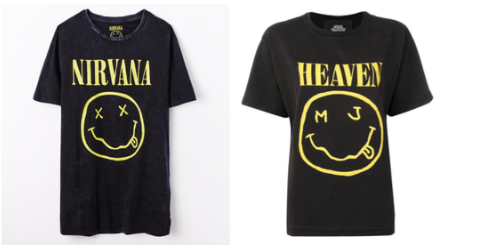
In this lawsuit, Nirvana claims that a Marc Jacobs shirt unlawfully copied a design created by the late Kurt Cobain in 1991. The design in question is an iconic design associated with Nirvana, consisting of a yellow happy face against a black background with an “X” in the place of each eye, a squiggly upward facing smile, and a small tongue sticking out to the right. In Nirvana’s most common use of the design, they include “NIRVANA” printed in all capital letters also in yellow above the happy face design. The allegedly infringing Marc Jacobs shirt includes the same happy face with tongue design, but instead with an “M” and a “J” for eyes and the word “HEAVEN” appearing in yellow capital letters and a similar font to that of Nirvana’s design above the happy face. It is important to note that Nirvana has been using this happy face design to identify their music since 1992 and have used the design on all of its merchandise, including short sleeved shirts similar to the one distributed by Marc Jacobs.


            In the case’s most recent development, U.S. District Judge John A. Kronstadt heard and decided Marc Jacobs’ motion to dismiss. In its motion, Marc Jacobs primarily argues that Nirvana does not possess a monopoly on the smiley face design by itself but rather, that its copyright registration covers additional elements, including “NIRVANA” above the face and the words “flower sniffin kitty pettin baby kissin corporate rock whores” on the back of the t-shirt. Marc Jacobs further claims that to the extent Nirvana’s copyright covers the smiley face design, it is a different one than that found on the fashion designer’s t-shirts, sweatshirts, and socks. Moreover, by replacing the smiley face’s crosses for eyes with the letters “M” and “J,” and the word “NIRVANA” with “HEAVEN,” Marc Jacobs argues that the design is not an exact replica of Nirvana’s well-known design and therefore does not infringe the copyright.

            Marc Jacobs’ other primary argument in its motion to dismiss centered around how Nirvana’s complaint allegedly contains no explanation of how Kurt Cobain, as original author for Nirvana’s smiley face, transferred his ownership rights to Nirvana. Only the legal or beneficial owner of an exclusive right under a copyright is entitled to institute an action for infringement. Additionally, Marc Jacobs argues that the publication date on Nirvana’s copyright application is false and therefore, their registration is invalid. The presumption of copyright validity may be rebutted in this way if Marc Jacobs could sufficiently show that Nirvana knew the publication date was inaccurate and this inaccuracy would have caused the Copyright Office to refuse the registration.

            Motions to dismiss are granted when the complaint lacks a cognizable legal theory or sufficient facts to support one. If granted, the claims upon which it is based are dismissed from the case. If denied, the case proceeds forward, potentially to trial. Here, Marc Jacobs, Saks, and Neiman Marcus attempted to dismiss all claims against them. In denying the motion to dismiss, the judge found Marc Jacobs’ arguments unpersuasive. For one, the judge determined that Nirvana sufficiently alleged the similarities between Marc Jacobs’ t-shirt design and the copyrighted design by including various images of the two designs and listing multiple similar features. The court also found that Nirvana had sufficiently alleged ownership because the copyright registration lists Nirvana as its initial author. Finally, regarding Marc Jacobs’ assertion that the date of publication of the copyrighted design is inaccurate, the judge determined that Marc Jacobs failed to show that the date is indeed inaccurate and further that the plaintiffs knew of any such inaccuracy. Thus, Marc Jacobs’ motion to dismiss was denied, which causes the case to proceed.

Read More

Does T-Mobile have the right to stop other companies from using the color magenta?

Deutsche Telekom, T-Mobile’s parent company, sent a cease and desist letter to Lemonade, an insurance start-up company, demanding that they discontinue using the color magenta in their marketing materials. Deutsche Telekom is the registered owner of a trademark on a specific shade of the color magenta, RAL 4010. 

According to the Lanham Act, trademarks are defined as any word, name, symbol, or device, or any combination thereof” that is used to identify and distinguish one’s goods or services from those of other sources. The overarching purpose of trademarks is to protect consumer confusion between product and service offerings. Further, pursuant to the United States Supreme Court, colors can be protected by a trademark “when that color has attained ‘secondary meaning’ and therefore identifies and distinguishes a particular brand (and thus indicates its ‘source’).” 

In this way, T-Mobile is not the only company to have trademarked a color. Indeed, numerous other companies have taken similar steps to protect their trade dress. For instance, Tiffany’s has trademarked their shade of “Tiffany box blue.” Similarly, Target has trademarked its iconic shade of red. As a further example, UPS has trademarked the brown that appears on its uniforms and trucks. 

Similar to trademarks for words and designs, an owner of a color trademark can sue another for trademark infringement if another uses that color or another “confusingly similar” shade. More particularly, the trademark owner must still prove that consumers are likely to be confused, mistaken, or deceived as to the affiliation, connection, or association of the other party using the similar shade or the approval by the trademark owner of that parties’ goods or services.  

T-Mobile received an injunction on Lemonade in Germany, which forced Lemonade to stop using the color magenta in relation to their company in Germany. Instead, temporarily, the insurance company has been using red. Moreover, in response to the injunction, Lemonade filed a motion with the European Intellectual Property Office (EUIPO) to invalidate T-Mobile’s trademark on magenta and also petitioned the German trademark office to remove Deutsche Telekom’s claim to any right on magenta as it relates to insurance. In this manner, Lemonade argues Lemonade and Deutsche Telekom are in two disparate markets, thereby decreasing like likelihood of customer confusion because a person is unlikely to confuse the two brands. T-Mobile maintains their color mark is associated with its brand “beyond the classic industry environment.”

In response, T-Mobile asserts that it does offer insurance on digital services, such as cybersecurity, and it sells other insurance policies to cover its devices. Lemonade also argues their shade of magenta differs from the one that Deutsche Telekom has trademarked and T-Mobile utilizes. In its social media campaign against T-Mobile, Lemonade even created a chart titled “some of the colors Deutsche Telekom thinks it owns,” where they have the trademarked shade of magenta side by side with the shade that they are using, as well as other colors that Deutsche Telekom has tried to prevent other companies from using. 

In an effort to defend themselves, Lemonade is using social media to gain attention for the case. Their instagram page has over 18 million views and their hashtag #freethepink is gaining attention. The social media campaign appears to be working, at least to some extent, as people have been expressing their unhappiness with the actions taken by Deutsche Telekom, stating that it is foolish to try to claim a monopoly on a color. In addition, people have stated that, by the standard set forth by T-Mobile, the telecom company should go after every entity that uses the color pink, including Victoria’s Secret and the breast cancer movement. While these are organizations in very different areas than Deutsche Telekom and utilize very different shades of pink, consumers are aiming to highlight their annoyance. 

Deutsche Telekom has not yet taken legal action against Lemonade in the United States. Instead, T-Mobile waited until Lemonade expanded to Germany prior to seeking any legal recourse. It remains to be seen whether Lemonade’s blatant disregard of the cease and desist letter from T-Mobile will spur further legal proceedings, including within the United States.

Read More

Are Skechers’ Skech-Air sneakers substantially similar to Nike’s patented VaporMax and Air Max 270?

On September 30, 2019, Nike filed a patent infringement lawsuit in the U.S District Court for the Central District of California against Skechers. Nike is claiming that Skechers is copying their patented designs for the Nike Air Max 270 and the Nike VaporMax. Nike is seeking damages in multiple areas, including those adequate to compensate for the alleged patent infringements, the total profit realized by Skechers, supplemental damages, and profits for any continuing post-verdict infringement until final judgement. Nike is also asking for treble damages, that is, increased damages up to three times the amount found or assessed. Finally, Nike seeks prejudgment and post-judgement interest on any damages or profits awarded, along with attorneys’ fees. 

A design patent protects the ornamental design of a product. While the product may be functional, design patents do not protect the functionality of the patent. Rather, to protect the functionality of a product, a utility patent is needed. To demonstrate design patent infringement, the plaintiff must prove that an ordinary observer would be unable to distinguish between the patented design and the accused product when they are side by side. This is referred to as the “ordinary observer” test. More specifically, this test, as most recently set forth by the Federal Circuit, provides that, “if, in the eye of an ordinary observer, giving such attention as a purchaser usually gives, two designs are substantially the same, if the resemblance is such as to deceive such an observer, inducing him to purchase one supposing it to be the other, the first one patented is infringed by the other.”

Notably, this has been modified to include the importance of prior art. Prior art includes any and all information that tends to show that a claimed invention was already known or would have been obvious at the time the patent application was filed. In the context of design patent infringement, the ordinary observer compares the patented design to the prior art. If the ordinary observer determines that the patented design is close to the prior art, smaller differences between the accused product and the patented design will be more important to the ordinary observer in determining whether infringement has occurred.

In the complaint, Nike asserts that Skechers previously admitted to taking inspiration from other sneaker companies and calling it “Skecherizing.” Nike believes that Skechers’ CEO, Robert Greenberg is to blame due to a Skechers corporate witness who previously testified that Mr. Greenberg “gives orders to knock-off competitors’ products.” There is a difference between inspiration and infringement. One can be inspired by a product and use that inspiration to either build upon what already exists, including ideas which are already patented. However, admiring a product so much that you simply recreate and distribute under your brand for your own profit constitutes infringement. As discussed above, Nike must prove that Skechers copied their patented designs by marketing and selling a design that is “substantially similar” to their patented. design. Further, to receive the treble damages it seeks, Nike also must prove that Skechers intentionally infringed its design.

This lawsuit is not the first between Nike and Skechers. In particular, Nike and its subsidiary, Converse, have filed previous lawsuits against Skechers for infringement. In the present complaint, Nike cites two pending lawsuits against Skechers. One is for the alleged infringement of the Converse high top design and the other is for the patented Nike Free and Flyknit designs. In the present complaint, Nike included side by side comparison photos for the two previusly pending lawsuits as well as the current dispute. Nike also mentioned a YouTube video review of the Skech-Air Atlas shoe, where the commentator describes the Skech-Air shoe as a “blatant Nike VaporMax knockoff” where they “remove all the things that make VaporMax good and replace them with BS.” 

Nike asserts that, as a business, they invest heavily in research and design which lead to “innovative footwear designs and technologies.” As such, they take their designs and ideas seriously and continually take steps to protect their intellectual property. Skechers, however, has a completely different view of its infringement litigation with Nike. According to a recent post by Skechers on Twitter, Nike has been notifying Skechers’ retail partners that Skechers is infringing on Nike’s patents. In response, Skechers asserts that Nike is bullying them and that this is Nike’s way of avoiding competing with Skechers. The court of public opinion apparently disagrees with Skechers. Numerous individuals have responded to Skechers’ Twitter with comments such as, “you even put AIR in the name,” “their creative department is an embarrassment,” and “Nike isn’t bullying you, they’re just standing up for themselves.”

Read More

Why is famous street-artist, Banksy, willing to protect his artwork through trademark but not copyright?

            Full Colour Black, a small greeting card company, has filed a claim to invalidate the trademark for Banksy’s artwork known as “flower thrower.” In addition, the greeting card company has been directly reproducing said artwork on greeting cards and other merchandise. The England-based street artist is fighting back against the card company in an attempt to protect his trademark.

            Banksy has been active since the 1990s as an anonymous street artist and political activist. Banksy is famously anonymous and made headlines last year for selling his Girl With Balloon painting for $1.4 million only for it to be shredded moments later. Banksy is using a shell company called Pest Control to handle the dispute. Through Pest Control, Banksy has trademarked his artwork as well as the word “Banksy.” The “flower thrower” work, officially “rage, flower thrower,” has been trademarked through Pest Control since 2014 and features a man with a bouquet of flowers in his hands in a stance appearing as though he is ready to throw said bouquet.

            Since Banksy registered his trademark for “flower thrower” five years ago, and he has not used the mark within this time period, such non-use is grounds for cancellation of the same in the European Union as well as the United Kingdom. As such, Full Colour Blank has come forward to invalidate Banksy’s registration for “flower thrower” in this manner. This system differs slightly from the United States, where, in order to register a trademark, one must prove that they are actively using their trademark on goods or services in commerce.  Banksy has publicly expressed his anger towards this situation, claiming the company is attempting to steal his name and artwork for their own profit.

            In response, Full Colour Black has stated that they are not trying to steal or profit off Banksy’s brand. They state that they are merely using his “flower bomber” painting for ornamental/decorative purposes and not to claim an association with Banksy or his brand. Moreover, they claim that obviously nobody would confuse their products for anything that relates to Banksy’s brand. Full Colour Black also defends such practice by stating “we legally photograph public graffiti and make it available to you – the public.” However, this claim does not address the fact that the company is doing so by selling, and therefore making a profit, on such allegedly “public” artwork. Instead, the card company accuses Banksy of “never mak[ing] anything available to his fans” that “cannot afford to buy one of his official canvases.”

            In response to the lawsuit, Banksy’s lawyers have advised him to open up a pop-up shop in order to protect his trademark by maintaining its registration. The store, set up in the south London town of Croydon, was called “Gross Domestic ProductTM” with a tagline of “Where art irritates life.” While not open about disclosing his identity, in an explanation of the store, Banksy openly discloses “This shop has come about as a result of legal action” and that he “has been advised the best way to prevent this is to sell his own range of branded merchandise.” This storefront was opened with the purpose of demonstrating proof of use of the “flower thrower” and other trademarks, thereby allowing Banksy to fight the claim against his intellectual property.

A trademarkis a word, phrase, symbol, and/or design that identifies and distinguishes the source of the goods of one party from those of others. A trademark is aimed at protecting the consumer by allowing them to know with certainty the source of certain products or services. Copyright, on the other hand, is aimed at protecting the creator and their creations. Both copyright and trademarks give monopolistic rights that allow their owners to profit from their own creations, and preventing others from profiting from creations that do not belong to them.

            Banksy, controversially, does not copyright his work and has been quoted saying “copyright is for losers.” Interestingly, then, it does not follow why Banksy would protect his work via trademark. In one sense, perhaps because trademark laws are aimed at protecting consumers by disallowing false associations of source for products and services, while copyright protects the authors of works from infringement, Banksy favors trademark.

            Some commentators have speculated that Banksy is against copyright not for moral or political reasons, but rather because in order to copyright his work, he would have to reveal his identity. However, this claim is wholly untrue. In the United States, one may register their copyright under a pseudonym and therefore need not reveal their true identity. Additionally, in the United Kingdom, there is no register of copyright works but instead, the copyright owner is granted protection automatically upon creation of an artistic work. Thus, the question remains why Banksy is willing to trademark, but not copyright his artwork. 

Read More

About Omni Legal Group

omni
The Omni Legal Group was founded in Los Angeles, California by Omid Khalifeh.

We Are Social

The Great IDEA Newsletter

The Great IDEA: Twitter and the Law How to avoid getting in Twouble Twitter makes it easy for users communicating to large audiences over the Internet. There's very little preparation that needs to go into what you're going to say and in seconds you can conceivably communicate your message to millions of people. Read More
  The Great IDEA: Apple Awarded Sexting Patent As technology increases our access to limitless information so does the need for parental controls on advanced devices. Clearly recognizing this need, Apple was recently awarded a patent for a "Text-based communication control for personal communication device." Read More

PATENT & TRADEMARK LAW FIRM

FREE CONSULTATION

Call us for support
310-276-6664

Latest Posts

Using Athlete NIL in Marketing: Legal Guidelines for Businesses
By Omid Khalifeh May 20, 2026
The EA Sports Comeback: How NIL Changed College Sports Forever 
By Omid Khalifeh May 15, 2026
AI and NIL Rights: Who Owns Your Digital Likeness in 2026
By Omid Khalifeh May 14, 2026
IP Risks When Hiring Freelancers & Developers: How California Businesses Protect Ownership
By Omid Khalifeh May 7, 2026
AI Voice Cloning and Brand Protection: What Every Business Owner Needs to Know
By Omid Khalifeh May 1, 2026

Posts pagination

« 1 … 22 23 24 … 38 »
SERVICES
  • Patents
  • Trademarks
  • Copyrights
  • Cyber Law
  • Trade Secret Law
  • Business Consultancy
  • Mediation
CONNECT WITH US

logo

855.433.2226

info@omnilegalgroup.com

OFFICE LOCATIONS

Los Angeles
2029 Century Park East, Suite 400,
Los Angeles, CA 90067.
Tel: 310.860.2000
Beverly Hills
9025 Wilshire Blvd., Suite 500,
Beverly Hills, CA 90210.
Tel: 424.901.8418
Santa Monica
2425 Olympic Blvd., #4000,
Santa Monica, CA 90404.
Tel: 310.276.6664
BUSINESS HOURS
Monday - Sunday: 9 AM to 5 PM

ABOUT USSERVICESCONTACT USRESOURCESPHILANTHROPY

Copyright 2026 Omni Legal Group - Patent & Trademark Law Firm in Los Angeles