
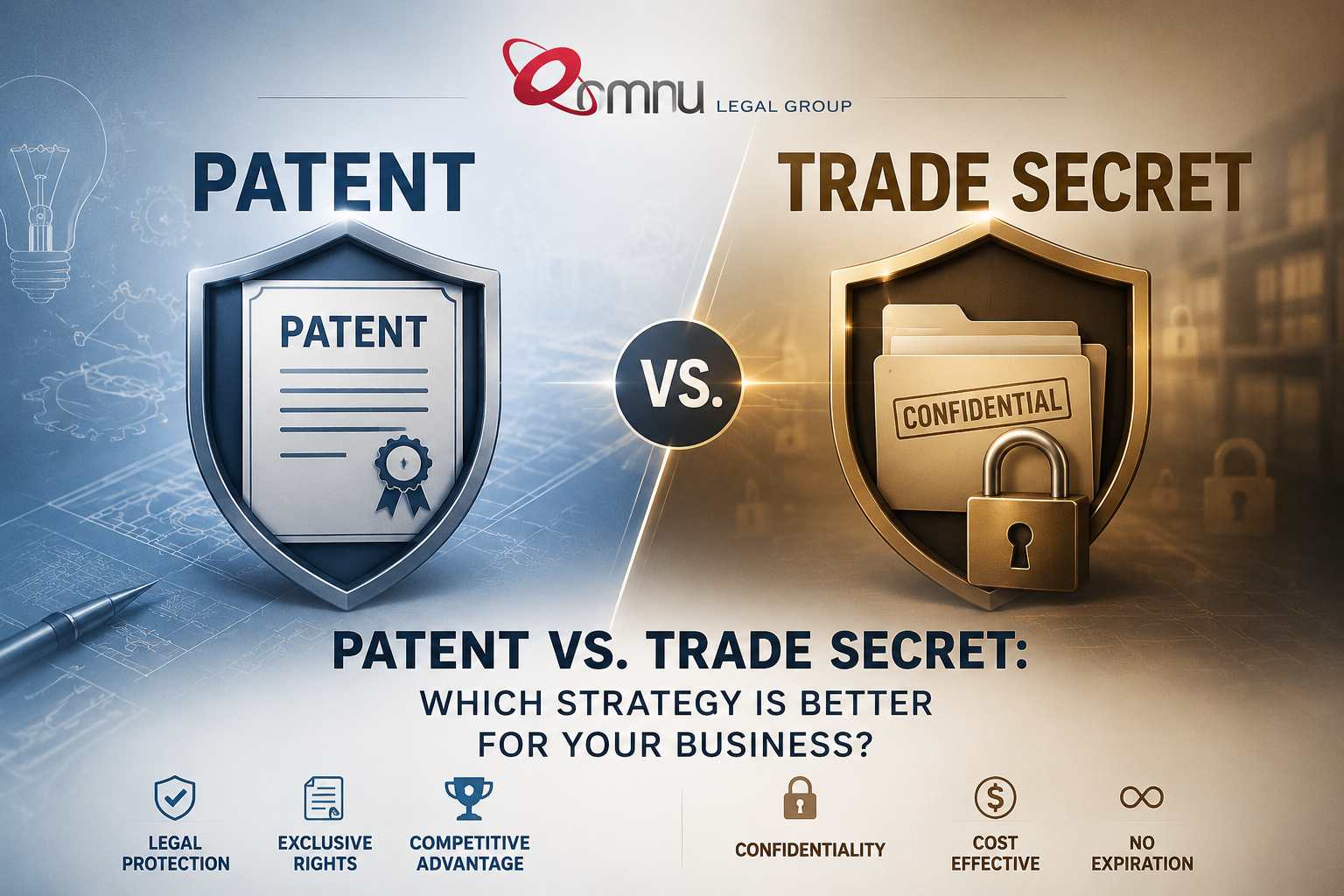
For innovative businesses throughout Los Angeles and California, intellectual property is often far more than a legal asset, it is the foundation of the company’s competitive advantage and long-term value. Whether you are developing groundbreaking software, a medical device, an advanced manufacturing process, a proprietary formula, or another innovative technology, how you choose to protect that innovation can have a significant impact on your ability to compete, attract investors, generate licensing opportunities, and achieve long-term business growth. Selecting the wrong protection strategy, or failing to protect your innovation altogether, can leave years of research, development, and investment vulnerable to competitors.
Two of the most powerful forms of intellectual property protection are patents and trade secrets. Although both are designed to help businesses preserve a competitive edge, they operate under fundamentally different legal frameworks and offer distinct advantages and limitations. A strategy that makes sense for one company may be entirely inappropriate for another, depending on the nature of the innovation, the industry, the likelihood of reverse engineering, commercialization plans, and long-term business objectives.
Understanding the differences between patents and trade secrets is essential for making informed business decisions. By evaluating the strengths, limitations, costs, and strategic implications of each approach, businesses can develop an intellectual property strategy that not only protects today’s innovations but also supports future growth, strengthens company value, and creates a lasting competitive advantage.
Patent Protection
A patent grants the inventor the exclusive right to prevent others from making, using, selling, or importing the patented invention for a limited period, provided the invention satisfies applicable legal requirements. In exchange for these exclusive rights, the inventor must publicly disclose how the invention works through the patent application.
Advantages of Patent Protection
One of the primary advantages of patent protection is the ability to enforce exclusive rights against competitors. If a patent is infringed, the patent owner may pursue legal remedies, including injunctions and monetary damages
Patents can also increase the value of a business by creating licensable assets, strengthening a company’s intellectual property portfolio, and enhancing investor confidence. For many startups, issued patents may serve as valuable assets during fundraising, acquisitions, or strategic partnerships.
Disadvantages of Patent Protection
Obtaining a patent can be both expensive and time-consuming. Patent application preparation, filing fees, examination costs, and legal expenses can represent a significant investment, particularly for startups with limited budgets.
Additionally, patents require public disclosure. Once published, the patent application reveals the details of the invention, allowing competitors to understand how it works. Although competitors cannot legally copy a patented invention during the patent term, they may attempt to design around the patent or build upon disclosed concepts after the patent expires.
Trade Secret Protection
A trade secret protects valuable confidential business information that derives economic value from not being generally known and is subject to reasonable measures to maintain its secrecy. Examples include manufacturing methods, proprietary algorithms, customer lists, pricing strategies, source code, formulas, and internal business processes.
Unlike patents, trade secret protection does not require registration or public disclosure.
Advantages of Trade Secret Protection
One of the greatest advantages of trade secret protection is that it can potentially last indefinitely. As long as the information remains confidential and reasonable safeguards are maintained, trade secret protection does not expire.
Trade secrets also avoid the substantial costs and delays associated with the patent application process. Businesses can often begin protecting confidential information immediately through nondisclosure agreements, employee confidentiality policies, access controls, and other reasonable security measures.
Disadvantages of Trade Secret Protection
Trade secret protection is only effective while the information remains secret. If a competitor independently develops the same technology or lawfully reverse engineers a product, trade secret law generally offers no protection.
Likewise, once confidential information becomes public through accidental disclosure, employee misconduct, or inadequate security practices, trade secret protection may be lost permanently.
Choosing the Right Strategy
The appropriate strategy often depends on the nature of the innovation and the company’s long-term business objectives.
Patent protection is often well-suited for inventions that are likely to be reverse engineered after reaching the marketplace. Mechanical devices, consumer products, medical technologies, and manufacturing equipment frequently fall into this category because competitors may be able to determine how they function simply by examining the finished product.
Trade secret protection is often more appropriate when valuable information can realistically remain confidential for many years. Manufacturing techniques, proprietary software algorithms, internal business methods, recipes, and customer analytics are common examples of assets that may benefit from trade secret protection.
In many cases, businesses use both strategies simultaneously. For example, a company may obtain patents covering its core technology while maintaining confidential manufacturing processes, pricing models, software code, or research data as trade secrets.
Frequently Asked Questions
Is a patent stronger than a trade secret?
Neither form of protection is universally better. A patent provides exclusive legal rights for a limited period in exchange for public disclosure of the invention, while a trade secret can potentially last indefinitely as long as the information remains confidential. The best choice depends on your business goals, the nature of the innovation, and whether competitors could easily reverse engineer it.
Can I protect the same innovation with both a patent and a trade secret?
In many cases, yes. Businesses often patent the core invention while protecting related confidential information, such as manufacturing methods, source code, customer data, pricing strategies, or proprietary processes, as trade secrets. A comprehensive intellectual property strategy may involve using multiple forms of protection together.
How long does patent protection last compared to trade secret protection?
A utility patent generally provides protection for 20 years from the filing date, provided maintenance requirements are met. Trade secret protection has no fixed expiration date and may last indefinitely, but only if the information remains confidential and the business takes reasonable steps to protect its secrecy.
What happens if someone independently develops my trade secret?
Trade secret law generally does not prevent competitors from independently developing the same technology or discovering it through lawful reverse engineering. Unlike patents, trade secrets protect against unauthorized acquisition, disclosure, or use of confidential information, not independent creation.
Should startups choose patent protection or trade secret protection?
There is no one-size-fits-all answer. Startups should evaluate factors such as the likelihood of reverse engineering, commercialization plans, investor expectations, available budget, and long-term business objectives before deciding which strategy is most appropriate. Many startups ultimately benefit from using both patents and trade secrets as part of a broader intellectual property strategy.
Need Guidance Choosing Between Patent and Trade Secret Protection? Speak to a Los Angeles IP Lawyer Today
Choosing between patent protection and trade secret protection is one of the most important intellectual property decisions a business can make. The right strategy depends on far more than simply selecting one form of protection over another. It requires evaluating the nature of your innovation, the likelihood that competitors could reverse engineer your product, your commercialization plans, your budget, your long-term business objectives, and whether your intellectual property will create greater value through public disclosure or continued confidentiality.
A well-planned intellectual property strategy can strengthen your competitive advantage, increase your company’s valuation, attract investors, support licensing opportunities, and position your business for sustainable growth. Conversely, choosing the wrong strategy or delaying important decisions can expose valuable innovations to unnecessary risk, reduce future business opportunities, and limit your ability to enforce your rights when they matter most.
At Omni Legal Group, our Los Angeles intellectual property attorneys work closely with startups, entrepreneurs, inventors, and established businesses to develop customized IP strategies that align with their business goals. We help clients evaluate whether patent protection, trade secret protection, or a combination of both offers the strongest path forward. Our team also assists with patent applications, trade secret protection programs, confidentiality agreements, nondisclosure agreements, intellectual property audits, licensing matters, and long-term portfolio development designed to maximize the value of your innovations.
The strongest intellectual property strategy is not about choosing the most popular option, it is about choosing the one that gives your business the greatest competitive advantage for years to come.
Contact Omni Legal Group today to schedule a confidential strategy session with one of our IP lawyers in Los Angeles. Call 855.433.2226 to speak with our legal team and learn how a strategic approach to patents and trade secrets can help protect your innovations, strengthen your market position, and support your company’s long-term success. Visit www.OmniLegalGroup.com to learn more.